academics
British vs American Curriculum: Which Is Better for Your Child in Addis Ababa?
British or American? The honest answer depends on where your child might study at 18. Here is how the two systems differ in structure, assessment, breadth and university entry, with what each really means for a family in Addis Ababa.
Families choosing a school in Addis Ababa usually end up comparing two traditions: the British approach, which most international schools here deliver through Cambridge, and the American approach. Each side’s marketing says it is better. Neither is, in general. One of them will usually be better for your child, and the deciding question is surprisingly specific: where might your child go to university?
Here is how the two actually differ, without the brochure language.
The short answer
- Choose the British (Cambridge) route if you want a clear, subject-by-subject structure, external exams that mean the same thing in any country, and depth in a few subjects at 16 to 18. It suits families who may move between countries, or who are aiming at UK, European, African or Commonwealth universities.
- Choose the American route if your child is almost certainly heading to a US university, you value breadth for longer, and you prefer continuous assessment through the year over big end-of-stage exams.
- Either route can reach either destination. The difference is how much extra work the crossing takes, which is explained below.
How the years line up
The two systems count differently, which confuses many parents in Addis. In England a child starts Year 1 at age five to six, after a Reception year. The UK government’s national curriculum page groups the years into Key Stages: Years 1 and 2 (ages 5 to 7), Years 3 to 6 (ages 7 to 11), Years 7 to 9 (ages 11 to 14) and Years 10 and 11 (ages 14 to 16), when students sit GCSEs or IGCSEs. Two more years lead to A Levels at 18.
In the United States, children start Kindergarten at about five and then move through Grades 1 to 12, which the US National Center for Education Statistics groups as kindergarten to Grade 8 and then Grades 9 to 12. As a rough rule, a British year number is one higher than the American grade for the same age: Year 2 sits alongside Grade 1, and Year 9 alongside Grade 8.
Schools in Addis Ababa label their classes in different ways, so always ask which class your child would join based on their date of birth, rather than matching names.
One curriculum versus many
The British side has a defined curriculum. Cambridge publishes a curriculum framework for each subject with stage-by-stage learning objectives, so a Year 4 science class in Addis is working toward the same goals as one in Lagos or Dubai.
The American side does not, which surprises many families. There is no single US national curriculum. The Common Core standards, the closest thing to one, are explicit that they "are not curricula", and adoption by states is voluntary (Common Core FAQ). Each state, district and school builds its own. An "American curriculum" school abroad is therefore only as good as that particular school’s design, which makes a visit and a look at real student work even more important.
How children are assessed
British-style schools lean on external assessment at key points: progress tests during primary and lower secondary, then IGCSEs at 16 and A Levels at 18. These are set and marked outside the school, so a grade means the same thing everywhere. The trade-off is pressure at a few big moments.
American schools lean on continuous assessment. Homework, quizzes, projects and participation all feed a grade point average (GPA) built up over four years of high school, plus admissions tests such as the SAT or ACT and, for stronger students, Advanced Placement (AP) exams. The College Board currently offers 43 AP subjects. A bad exam day matters less; consistency all year matters more.
Breadth or depth
This is the real philosophical difference. An American high school student keeps studying a broad spread of subjects until graduation and specialises at university. A British-route student narrows at 16, typically to three A Levels, and studies them in real depth. The University of Warwick, for example, benchmarks its entry requirements as "typically 3 A Levels".
Neither is better. A child who knows they love the sciences may thrive with depth; a child who is still exploring may prefer breadth for longer. Note that the choice only bites at 16. Up to Year 9 or Grade 8, both systems teach a broad curriculum.

Getting into university from each route
This is where the decision really lives, and the details matter more than the slogans.
From the British route to the United States
A Levels are well understood in America. Cambridge International states that more than 1,000 US universities formally accept its AS and A Levels, including every Ivy League university, and that strong grades can earn up to a year of course credit. Individual universities set their own terms: the University of Southern California looks for predicted A Levels of at least B in three subjects and will not admit on IGCSEs alone. Some still want an admissions test as well. Harvard expects the SAT or ACT and accepts A Level results instead only when a student cannot access those tests.
From the American route to the UK and elsewhere
A US high school diploma on its own is usually not enough for selective UK universities. Warwick, for instance, asks for the diploma plus the equivalent of three A Levels, met through four or five AP exams with top scores (Warwick entry requirements for US applicants). A strong American-route student can get there, but needs to plan their AP choices years ahead.
The pattern: A Levels travel to the US fairly smoothly, with a test added. The US diploma travels to the UK only when backed by APs. For a family that does not yet know which side of the Atlantic, or which continent, their child will end up on, that asymmetry is worth weighing.
What it means for families in Addis Ababa
- Diplomatic and NGO families who move every few years usually find a Cambridge school easier to transfer between, because the same frameworks run in schools in many countries.
- Ethiopian families thinking about universities in the UK, Europe, Canada, Africa or the Middle East are generally well served by the British route, with the US still open.
- Families with a firm US plan, or a child already deep in an American school, may be better staying on that route.
- Whichever you choose, continuity matters more than the label. Switching systems repeatedly costs a child more than either system does.
There is also a third option many Addis families weigh, the International Baccalaureate. We compare it with Cambridge in Cambridge or IB in Addis Ababa?, and with the Ethiopian national curriculum in Cambridge, IB or national curriculum.
Questions parents ask about British and American curricula
Is the British or American curriculum better? Neither is better in general. The British (Cambridge) curriculum offers a defined structure, external exams and depth in a few subjects from 16, and its A Levels are widely accepted, including by more than 1,000 US universities. The American system offers breadth for longer and continuous assessment, and suits students set on a US university. The right choice depends mainly on where your child may go to university.
Do American universities accept A Levels? Yes. Cambridge International states that more than 1,000 US universities formally accept its AS and A Levels, including all Ivy League universities, and strong grades can earn up to a year of credit. Some universities, such as Harvard, still expect the SAT or ACT as well, so check each university’s international admissions page.
Can you get into a UK university with an American high school diploma? Usually only with additional exams. Selective UK universities typically ask for the diploma plus Advanced Placement results; Warwick, for example, looks for four or five AP exams with top scores as the equivalent of three A Levels.
What is the difference between Year and Grade? British schools number years from Year 1 (age five to six), while American schools start with Kindergarten at about five and then Grade 1. As a rough rule the British year number is one higher than the American grade for the same age, so Year 9 sits alongside Grade 8. Ask any school which class your child would join by date of birth.
Is the Cambridge curriculum the same as the British curriculum? Not exactly. Cambridge is an international curriculum from Cambridge University Press and Assessment, designed for schools around the world and built on the British tradition. It is not the national curriculum of England, but it follows the same broad structure and leads to IGCSEs and A Levels.
Where this happens at Nucleus
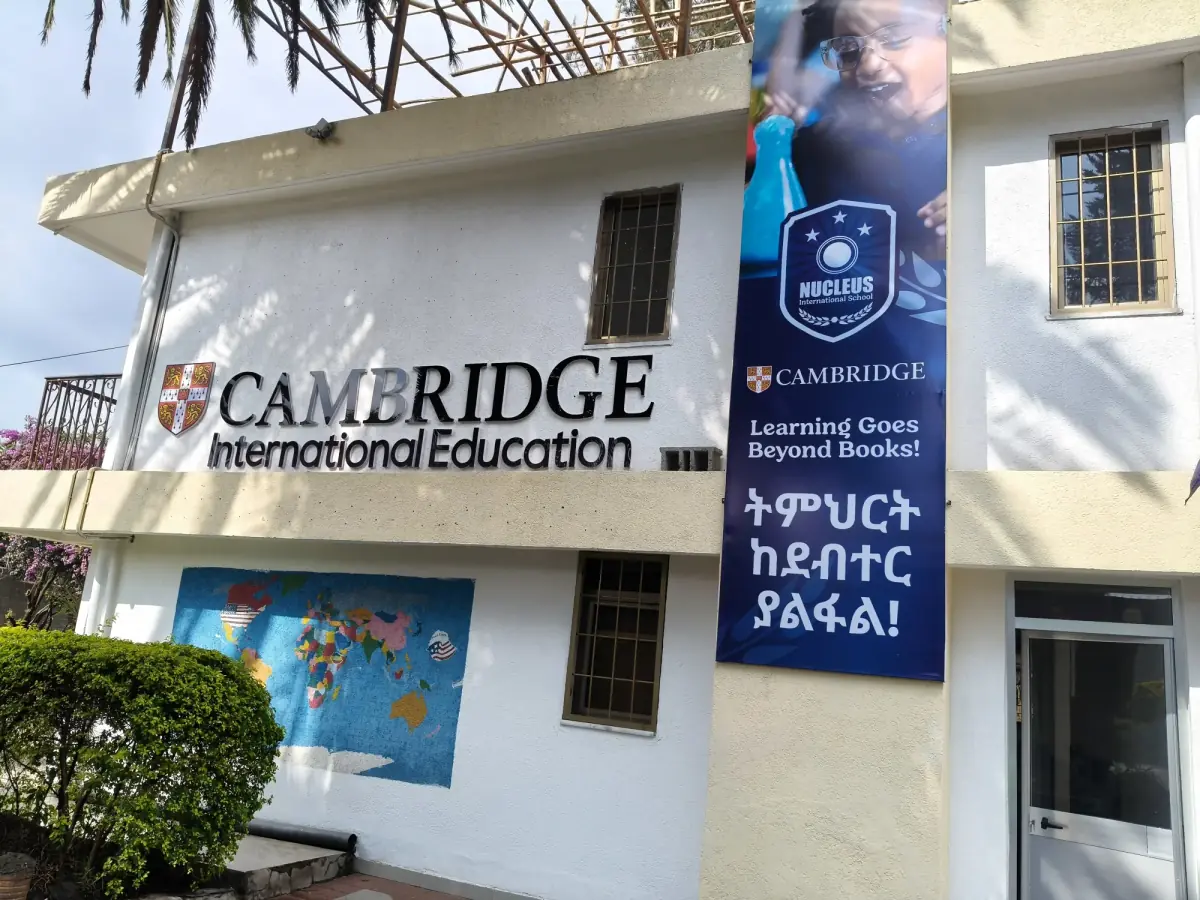
Nucleus International Schools teaches the international Cambridge curriculum from Foundation to Year 9 (Preschool to Grade 8). For the 2027/28 academic year we will open Grades 9 to 12 at our new Totot Campus in Gerji, with a Cambridge IGCSE and A Level pathway, so a child can complete the whole British route with us.
Our community includes families from Ethiopia, Canada, the United States, France, Nigeria, Turkey, India and beyond, so we have this conversation often. Call +2519 81 99 99 22 to talk it through, or read about the Cambridge pathway at Nucleus.