academics
The Cambridge Curriculum in Ethiopia: How It Works from Age 3 to 19
What the Cambridge curriculum actually is, how its five stages fit together from age 3 to 19, how children are assessed, what it costs a child to switch in or out, and the questions that tell you whether a school in Ethiopia really teaches it.
More and more schools in Addis Ababa describe themselves as Cambridge schools. Some teach the full Cambridge pathway. Some use Cambridge textbooks inside a different programme. Some have a Cambridge logo on the gate and little else. From the outside they look the same.
This guide explains what the Cambridge curriculum really is, how it is structured from age 3 to 19, how children are assessed at each stage, and what to ask so you can tell the difference.
What the Cambridge curriculum is
The Cambridge curriculum is published by Cambridge University Press and Assessment, part of the University of Cambridge, through its schools arm, Cambridge International Education. It describes itself as the world’s largest provider of international education for 3 to 19 year olds, with nearly two million learners (Cambridge International). Its 2025 parent guides put the community at more than 10,000 schools in over 160 countries.
It is built on the British tradition but it is not the national curriculum of England. It is designed to be taught anywhere, and schools are expected to adapt it to their own country and culture. That is why a school in Addis can teach Amharic, Ethiopian history and local examples alongside the Cambridge curriculum while still working toward the same international standards.
Cambridge also has a history with Ethiopian education beyond private schools. In its own case study, Cambridge describes supporting the Ministry of Education’s general education curriculum reform, including training 3,200 textbook authors, editors, designers and reviewers.
The five stages, from age 3 to 19
Cambridge calls the full journey the Cambridge Pathway. Each stage has its own curriculum and assessments, and each one leads into the next (Cambridge Primary parent guide):
- Cambridge Early Years, ages 3 to 6: a play-based programme across six connected learning areas. Read more in our guide to the Cambridge Early Years curriculum.
- Cambridge Primary, ages 5 to 11, Stages 1 to 6: up to 13 subjects, with English, mathematics and science at the core. See Cambridge Primary subjects and stages, and what children learn in Year 1.
- Cambridge Lower Secondary, ages 11 to 14, Stages 7 to 9: the same subjects at greater depth, preparing for IGCSE. See Cambridge Lower Secondary explained.
- Cambridge Upper Secondary, ages 14 to 16: Cambridge IGCSE, with more than 70 subjects to choose from, graded A* to G.
- Cambridge Advanced, ages 16 to 19: Cambridge International AS and A Levels, with more than 50 subjects.
A school does not have to offer every stage. Many in Ethiopia teach Early Years to Primary, or Primary to Lower Secondary, and some only IGCSE and A Level. Ask which stages are taught at the school today, and where your child goes next.
How it is different in the classroom
Three features shape a Cambridge classroom more than any textbook.
Learning objectives, stage by stage
Every subject has a curriculum framework that sets out exactly what a child should learn at each stage. Teachers plan from those objectives, which means a parent can ask, at any point, "what is my child working on this term?" and get a precise answer.
Thinking and working, not just knowing
Cambridge science includes a strand called Thinking and Working Scientifically, and maths a strand called Thinking and Working Mathematically (Cambridge Primary science). Children are assessed on whether they can plan an investigation, spot a pattern or explain their method, not only on whether they remember the answer. That is a real break from the memorise-and-repeat model many parents grew up with.
The five learner attributes
Since 2011 Cambridge has designed its programmes around five attributes it wants every learner to develop: confident, responsible, reflective, innovative and engaged (Cambridge learner attributes guide). In practice that means lessons where children discuss, defend a view, work in groups and reflect on how they learned.

How children are assessed
Cambridge assessment changes with age, and much of it is optional, so ask each school what it actually uses.
- Early Years: no tests at all. Teachers observe children as they learn and track progress against the framework (Cambridge Early Years assessment).
- Primary and Lower Secondary: Progression Tests in English, maths and science, marked by teachers, available from Stage 3. They show where a child is, rather than pass or fail.
- End of Primary and end of Lower Secondary: Cambridge Checkpoint, externally marked by Cambridge in English, maths and science, with Global Perspectives as an option. Results come with an international benchmark. From 2026 there are three test series each year, in March, May and October (Checkpoint FAQ).
- IGCSE at 16 and A Levels at 18: formal qualifications, externally set and marked.
Recognition: what a Cambridge education opens up
Cambridge qualifications are widely recognised. In the UK, Cambridge IGCSE is accepted as equivalent to the GCSE, and Cambridge International A Levels are recognised by UK universities (IGCSE parent guide). Cambridge also states that more than 1,000 US universities formally accept its AS and A Levels, including every Ivy League university.
For families who may move, the more immediate benefit comes earlier. Because the same frameworks run in thousands of schools, a child moving between Cambridge-registered schools, say from Addis Ababa to Nairobi, Dubai or London, usually picks up close to where they left off.
Questions to ask a school that says it teaches Cambridge
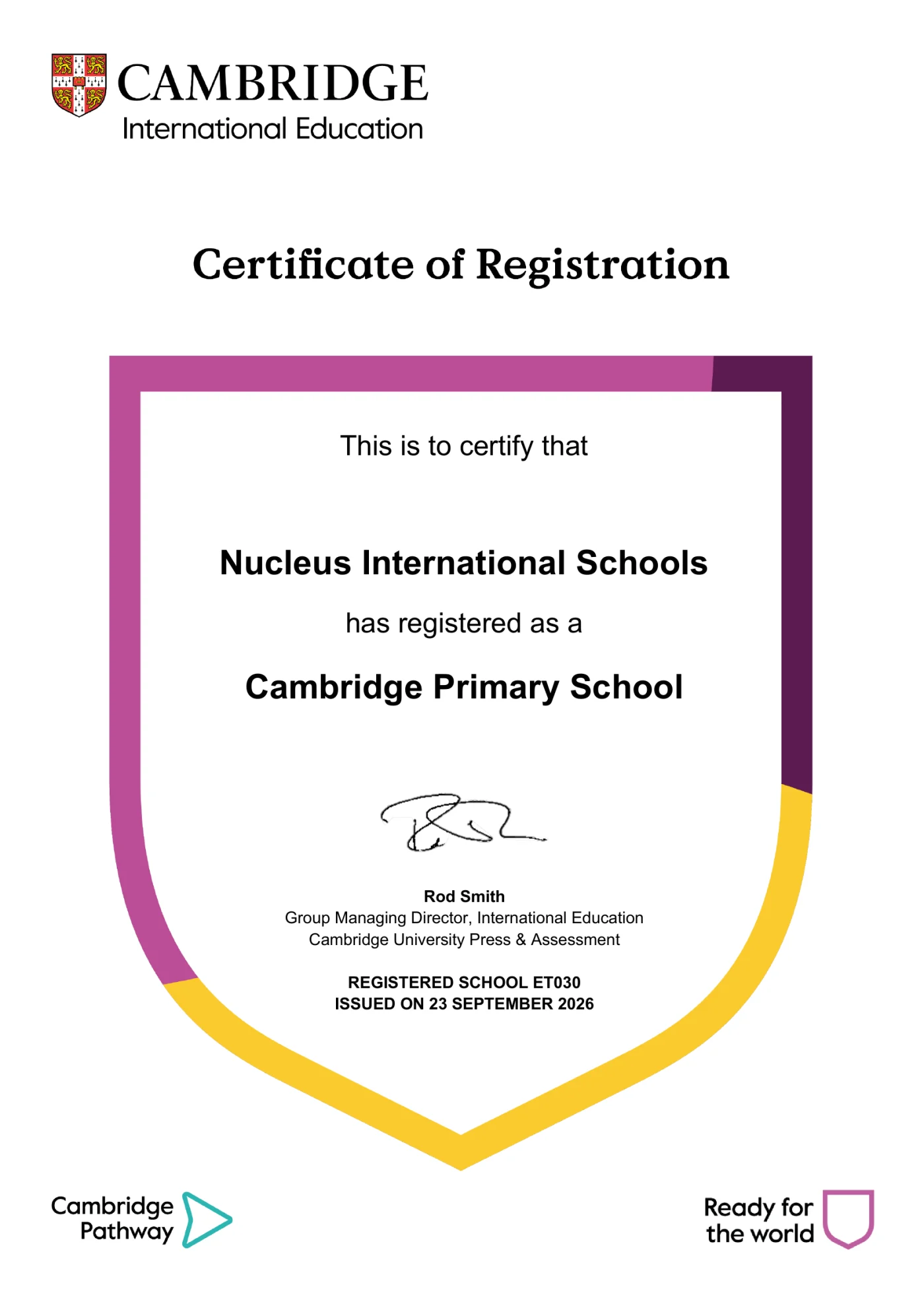
- Is the school registered with Cambridge International, and for which programmes? A registered school can show its certificate.
- Which Cambridge stages are taught at my child’s age this year?
- Which Cambridge subjects are taught, and which subjects come from another curriculum?
- Does the school use Progression Tests, and does it enter students for Checkpoint?
- What training in the Cambridge approach have the teachers had?
- Where can my child continue after the last year this school offers?
A school that genuinely teaches the Cambridge pathway answers all six quickly and in detail. For a wider shortlist, see our guide to Cambridge schools in Addis Ababa.
Questions parents ask about the Cambridge curriculum
What is the Cambridge curriculum? The Cambridge curriculum is an international programme from Cambridge University Press and Assessment for learners aged 3 to 19. It runs in five stages: Early Years, Primary, Lower Secondary, Upper Secondary (IGCSE) and Advanced (AS and A Level). Each subject has stage-by-stage learning objectives, and it is taught in more than 10,000 schools in over 160 countries.
Is the Cambridge curriculum recognised in Ethiopia? Yes. Cambridge programmes are taught in a number of private and international schools in Ethiopia, and Cambridge IGCSE and A Level qualifications are recognised by universities worldwide. Families planning to re-enter the Ethiopian national system later should ask the school and the Ministry of Education about equivalence for their child’s grade.
What age does the Cambridge curriculum start? Cambridge Early Years starts at age 3, Cambridge Primary at about 5, Lower Secondary at about 11, IGCSE at about 14 and A Levels at about 16.
Is the Cambridge curriculum hard? It is demanding in a different way from memorisation-based systems. Children are expected to explain their reasoning, investigate and apply what they know. Most children adapt well when the teaching is good, and the stage-by-stage objectives make it clear what they need to master next.
What is the difference between Cambridge and the Ethiopian curriculum? The Ethiopian national curriculum is set by the Ministry of Education and leads to national examinations. The Cambridge curriculum is international, taught in English, assessed by Cambridge, and leads to IGCSE and A Level qualifications recognised worldwide. We compare them in more detail in Cambridge, IB or national curriculum.
Where this happens at Nucleus
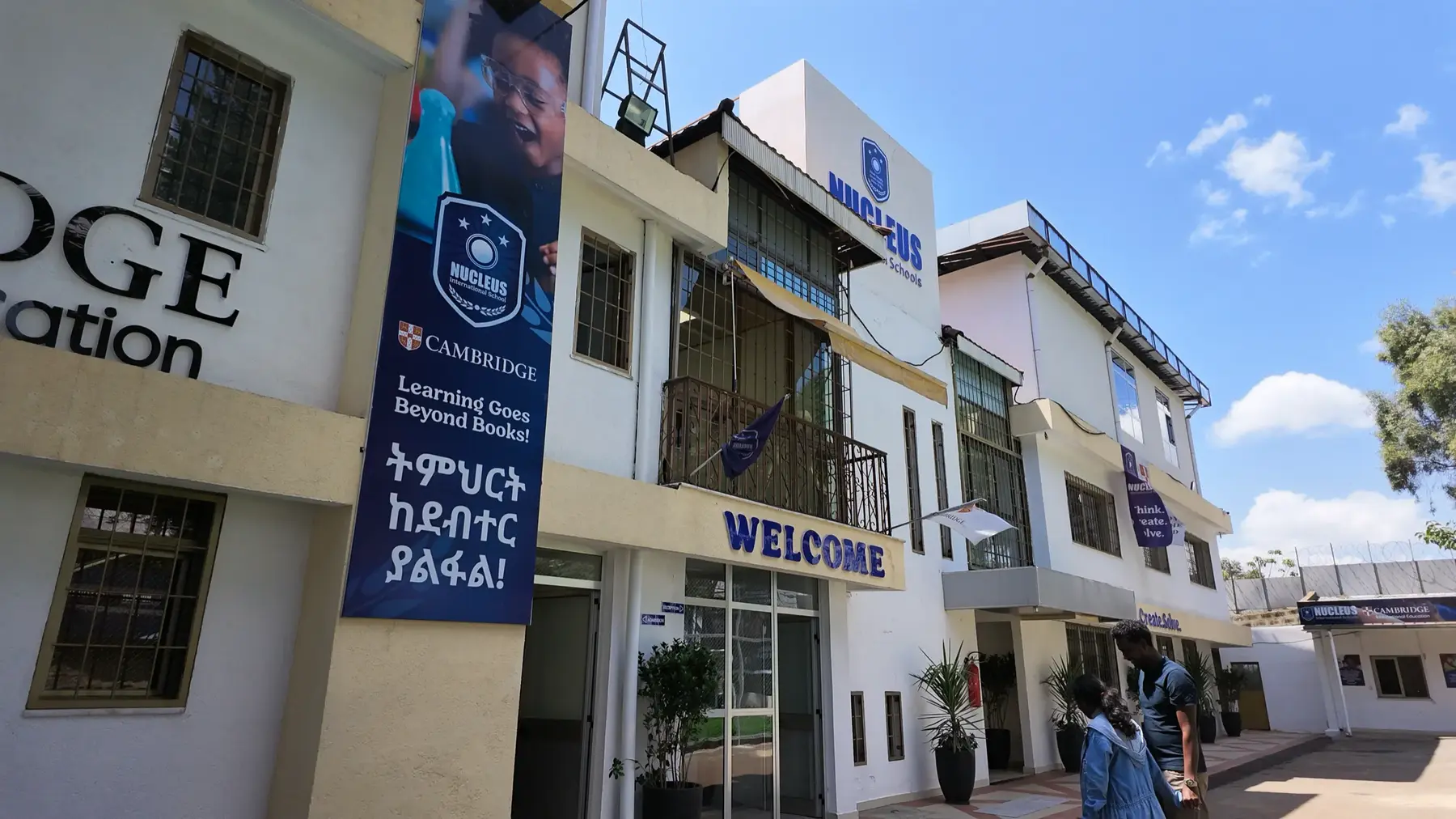
Nucleus International Schools in Addis Ababa is registered with Cambridge International and teaches the international Cambridge curriculum from Foundation to Year 9 (Preschool to Grade 8) at our Abo Mekanisa and Sarbet Vatican campuses. Our Totot Campus in Gerji opens Grades 9 to 12 for the 2027/28 academic year, with a Cambridge IGCSE and A Level pathway.
Ask us the six questions above. To visit, call +2519 81 99 99 22, or see the Cambridge pathway at Nucleus.